平 阴 玫 瑰 · 中 国 玫 瑰 之 乡
Steam-distilled oil, hydrosol, absolute and food-grade buds from Rosa rugosa cv. Plena. Dawn-harvested, distilled at origin, shipped with COA, MSDS and GC-MS per batch.
Everything below is made in Pingyin from the same harvest. Prices are quoted per inquiry (FOB Qingdao) because rose oil is priced by batch and season — but MOQs, pack sizes and documents are stated upfront, the way serious buyers expect.
Typical values for Pingyin Rosa rugosa cv. Plena. The binding figures for your order are the COA and GC-MS report issued for the actual batch — both are sent before payment.
Peer-reviewed GC-MS profiling of industrial Pingyin rose oil (R. rugosa cv. Plena) consistently shows an unusually high citronellol share — around 48% in comparative studies, reported up to ~54% — giving the oil its fresh, sweet, slightly green rose character, distinct from Damask oils.
Bar length is drawn on a 0–60% scale (share of the whole oil), so lengths compare directly.
The remaining share is made up of linalool, citronellyl esters, farnesol, eugenol, rose oxides and 140+ further trace compounds — not charted, because published studies report them as a distributed balance rather than a single figure.
Indicative ranges compiled from published GC/MS studies of Chinese industrial rose oils (Molecules 2023, 28, 1281) and Pingyin PREO research (Int. J. Mol. Sci. 2026). 150+ compounds have been detected in Chinese rose oils. Always judge a supplier by the batch GC-MS — ours travels with the goods.
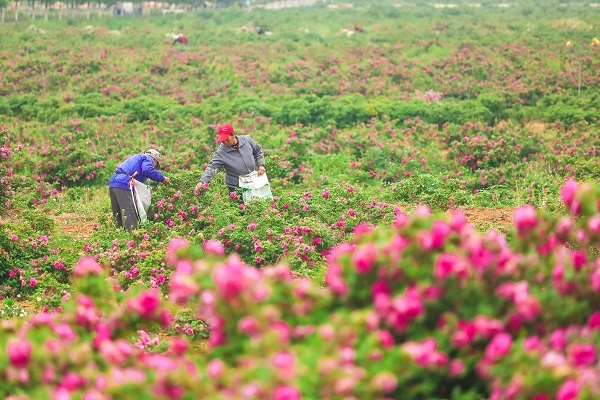
Roses have been cultivated in Pingyin since the Tang dynasty — over 1,300 years. The county sits at 36°N, ringed by hills, watered by the Yellow River and spring water, with deep, slightly acidic brown soils and a wide day–night temperature gap. The result is a rose with large, thick, intensely fragrant petals and one of the highest oil yields in China.
The core bloom lasts only about three weeks, from late April to mid-May. Aroma is won or lost in those days — so picking and distilling are organised around the flower, not the factory clock.
Flowers are hand-picked between roughly 5–9 a.m., half-open, when volatile aromatics peak and before the sun drives them off.
Late Apr – Mid MayFresh petals go into stainless steam stills the day they are picked. Oil and hydrosol are separated from a single distillation — nothing is reconstituted.
Within hoursEvery batch is checked for appearance, density, refractive index and full GC-MS composition against the national standard for double-petaled red rose oil.
COA + GC-MSOil in epoxy-lined aluminium bottles or fluorinated drums; hydrosol in food-grade HDPE; buds in nitrogen-flushed or vacuum packs. Full export documents with each shipment.
FOB Qingdao
Pingyin producers run automated cosmetics and filling lines alongside bulk raw-material production, so the same partner can supply your bulk drum and your finished retail bottle.
Different species. Damask oils come from Rosa damascena; Pingyin oil comes from Rosa rugosa cv. Plena, bred over centuries for thick, oil-rich petals. Its GC-MS signature is citronellol-led (~48–54%) with a fresher, greener-sweet top note, and it carries China–EU GI protection for the Pingyin name. Many perfumers use it where a bright, natural rose heart is wanted
Yes — sampling first is the normal route. A 10 ml oil sample with its batch COA and GC-MS is the fastest way to evaluate us against your current supplier. Add “Sample” items in the inquiry basket below.
The bulk oil is single-origin, steam-distilled and undiluted — no synthetic citronellol, no carrier, no reconstitution. That claim is checkable: the GC-MS chromatogram for your batch shows the full natural compound distribution (150+ detected compounds in published profiling).
Distillation follows the bloom: late April to mid-May. Fresh-season oil ships from late May; previous-season stock is available year-round and is what most annual contracts draw on. Booking during harvest secures allocation.
Pingyin double-petaled red rose is the only rose approved in China as a medicine–food homologous variety, and the buds, petals and hydrosol are widely used in teas, beverages, bakery and confectionery. Tell us your destination market and application in the inquiry, and we will confirm the right grade and documents.
Essential oil: 24 months sealed, cool and dark. Hydrosol: 12 months. Dried buds: 12–18 months in sealed, dry storage. Storage guidance is printed on every COA.
Add products from the catalogue, fill in your details, then copy the ready-made inquiry or open it in your email app. A serious inquiry gets a serious answer: batch number, COA figures, price and lead time — not a brochure.
Submit sends your inquiry to our server so we can reply. Copy and email keep the text on your device — nothing is uploaded unless you press Submit.